

Key Takeaways
- Artificial intelligence (AI) is personalizing home searches and streamlining decision-making processes.
- Virtual and augmented reality (VR/AR) offer immersive property tours, reducing the need for physical visits.
- Internet of Things (IoT) devices provide valuable data that influences home design and functionality.
- Blockchain technology is enhancing transparency and security in real estate transactions.
- Smart home features are becoming standard expectations among modern homebuyers.
Table of Contents
- AI: Personalizing Home Searches
- VR and AR: Immersive Property Tours
- IoT: Influencing Home Design
- Blockchain: Enhancing Transactions
- Smart Home Features: Standard Expectations
- Data-Driven Decision Making
- The Role of Social Media
- Conclusion
In the ever-evolving real estate landscape, technology is revolutionizing how individuals search for, evaluate, and purchase homes. From artificial intelligence to virtual reality, these advancements are not only enhancing the homebuying experience but also setting new standards for efficiency and personalization. For those navigating the dynamic Queen Creek market, partnering with seasoned professionals like Queen Creek real estate experts The Gillette Group can provide invaluable insights and guidance. Led by industry leader Shannon Gillette, The Gillette Group is renowned for innovative marketing, cinematic video production, and cutting-edge technology, helping hundreds of families each year achieve their real estate dreams. Serving clients across the Valley, they offer unmatched marketing exposure for sellers and exclusive opportunities for buyers, delivering a luxury experience to every client, regardless of price point.
AI: Personalizing Home Searches
Artificial intelligence is revolutionizing the homebuying process by offering personalized property recommendations tailored to individual preferences. Platforms like Zillow leverage AI to analyze user data for more relevant listings, enhancing the overall buying experience. AI-powered chatbots improve communication for buyers and sellers by providing instant responses, while predictive analytics utilize big data to forecast market trends, aiding in strategic decision-making. Additionally, features like facial recognition in real estate apps enhance security during transactions.
VR and AR: Immersive Property Tours
Virtual and augmented reality technologies enable buyers to remotely explore homes through high-resolution 3D walkthroughs and interactive floor plans. These innovations are especially advantageous for out-of-town buyers or those with limited time, as they expedite the selection process. Enhanced AR apps enable users to visualize renovation ideas by superimposing furniture and fixtures onto spaces, helping both buyers and sellers create dynamic listings. This technology lowers barriers for buyers in competitive markets, making essential information and experiences easily accessible.
IoT: Influencing Home Design
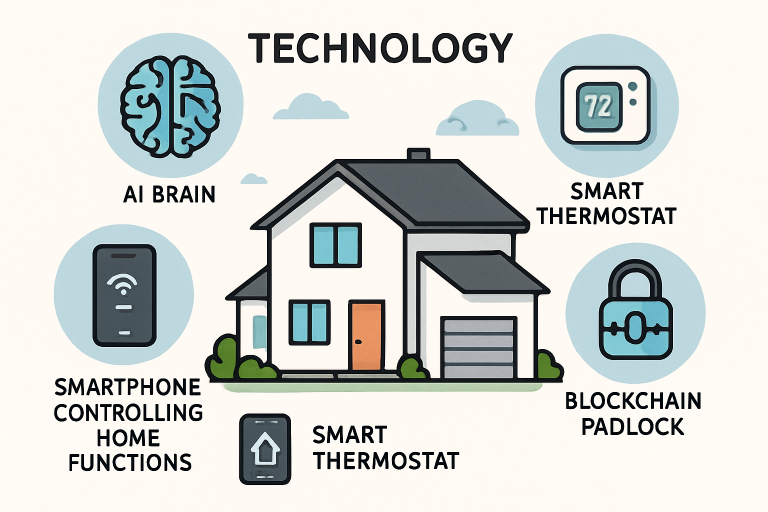
The rise of Internet of Things (IoT) devices in homes is generating extensive data on space utilization, which helps architects and builders design homes that better cater to modern occupants. This data has prompted features such as dedicated workspaces in new constructions, while smart thermostats, connected appliances, and advanced security systems shape homeowner interactions. IoT devices provide ongoing feedback on energy usage and air quality, leading to greener, healthier homes, lower bills, enhanced safety, and improved control for homeowners.
Blockchain: Enhancing Transactions
Blockchain technology is bringing unprecedented transparency and security to real estate transactions. By creating immutable records of property histories and ownership, blockchain reduces the risk of fraud and streamlines the buying process. Smart contracts automate various steps, ensuring that all parties fulfill their obligations before the transaction is finalized.
The adoption of blockchain in property records also enables tokenization—a process that divides tangible assets, such as real estate, into digital tokens, thereby broadening investment opportunities for more people. This could democratize real estate investing by lowering barriers such as high down payments and costly fees often associated with traditional investment approaches. Ultimately, these changes promise to build trust and stability within the real estate ecosystem, benefiting everyone from first-time buyers to seasoned investors.
Smart Home Features: Standard Expectations
Modern homebuyers increasingly demand smart home features as standard amenities, such as systems for controlling lighting, temperature, security, and entertainment, which enhance convenience and energy efficiency. Builders are now integrating these technologies during construction to appeal to tech-savvy consumers. Common voice-controlled assistants like Amazon Alexa and Google Home enable simple command operations, while advanced security features, including smart locks and motion-activated cameras, offer enhanced safety. Eco-friendly technologies like automated sprinkler systems and solar panel monitoring are also attracting buyers focused on sustainability. The ability to remotely manage home functions, such as adjusting thermostats or unlocking doors for deliveries, is becoming essential for modern homeowners.
Data-Driven Decision Making
Access to comprehensive data is empowering buyers to make informed decisions. Online platforms provide detailed information on market trends, neighborhood statistics, and property histories. This transparency allows buyers to assess a property’s value and potential more accurately, leading to more confident purchasing decisions.
Advanced analytics integrate factors such as commute times, school ratings, and local amenities, allowing prospective buyers to compare multiple properties not just on price but also on suitability for their lifestyle. Interactive maps and data dashboards also highlight future development plans and local infrastructure projects, providing context that was once available only to insiders. As a result, buyers now have the tools to evaluate both short- and long-term prospects for their investments, making data literacy a key advantage in tomorrow’s real estate market.
The Role of Social Media
Social media platforms have become influential tools in the homebuying process. Buyers use these channels to research neighborhoods, connect with real estate professionals, and view property listings. The visual nature of platforms like Instagram and Pinterest also helps gather design inspiration and envision potential homes.
Video tours, live Q&A sessions with real estate agents, and virtual open houses have become commonplace on platforms such as Facebook and YouTube. Real estate influencers and local community groups further foster engagement and trust, giving buyers a behind-the-scenes look at market dynamics, neighborhood culture, and the homebuying journey itself. This access to real-time information and authentic peer feedback is instrumental in guiding decisions, enhancing buyer confidence in an industry that once relied solely on static listings and scheduled showings.
Conclusion
Technology is undeniably reshaping the real estate landscape, offering tools and resources that make the homebuying process more efficient, personalized, and transparent. As these advancements continue to evolve, buyers can expect an increasingly seamless journey from search to purchase, tailored to their unique preferences and needs.
The integration of emerging technologies into the real estate sector signals a future in which buyers, sellers, and agents interact more effectively within an ecosystem defined by accessibility, innovation, and trust. By leveraging these digital advances, tomorrow’s homebuyer will experience unprecedented empowerment and satisfaction at every stage of their real estate journey.